










Why nonprofit leaders need agile
Since graduating from college, I have worked at two companies. The first was one of the largest nonprofits in the world. The second is a thriving SaaS startup. While both jobs have been immensely fulfilling, in many ways, they could not be more different.
The nonprofit was more than just a fantastic place to work—it was a meaningful calling. Many nonprofit employees feel this same compulsion to a world-altering mission. But the organization experienced the same issues as any large enterprise: Too often it was slow to change, heavily-laden with processes, and championed compliance over innovation. On the other hand, at Lessonly (the tech company), my team champions an Agile methodology of continuous rapid improvement—and it has radically changed how I view work. That’s why I’m convinced, nonprofits who truly want to maximize the impact of their limited resources should adopt the Agile methodology.
What is Agile?
Agile was developed by a group of software developers back in the early 2000s on a ski retreat at Snowbird, Utah. They decided that the world needed a new way of developing software, one that prioritized experimentation, iteration, and speed. Here’s the manifesto they developed:
We are uncovering better ways of developing
software by doing it and helping others do it.
Through this work we have come to value:
Individuals and interactions over processes and tools
Working software over comprehensive documentation
Customer collaboration over contract negotiation
Responding to change over following a plan
That is, while there is value in the items on
the right, we value the items on the left more.
This manifesto led to a series of principles, and later tactics—one of which is Scrum.
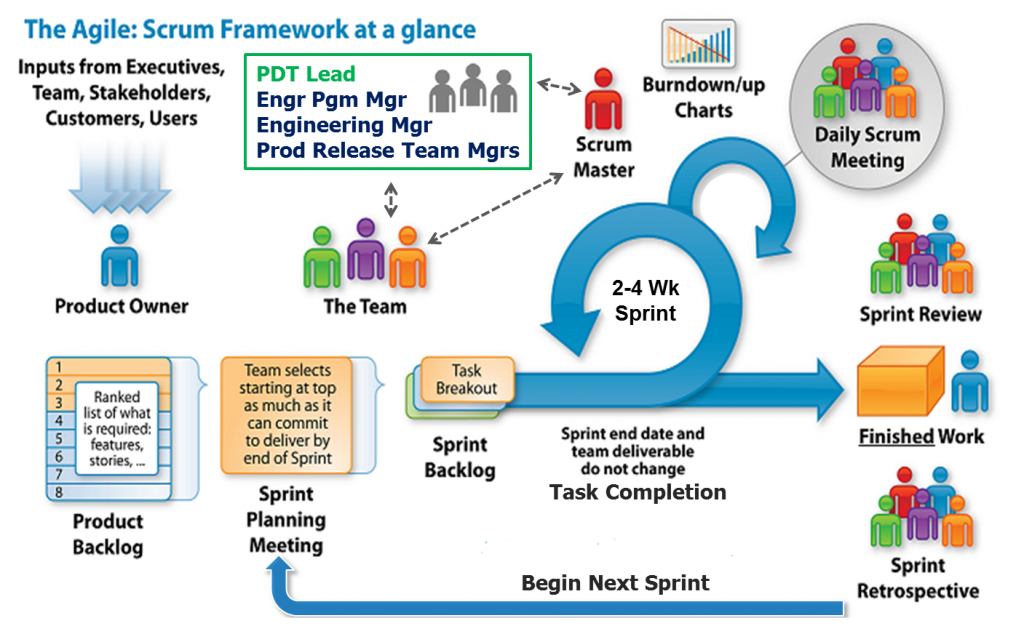
Scrum: A Framework for Employing Agile
Source: http://agilebrick.com/images/agile-process-1.png
In a software engineering or product context, Scrum looks a bit like this.
If that’s intimidating, fear not. Our marketing team uses a modified version of Scrum. You can read exactly how we use Trello to accomplish that, here. The long and short is this: 1) We hold a sprint meeting and commit to accomplish a series of projects/tasks in the next week; 2) We reinforce progress on those projects with daily, 15-minute stand-ups where we discuss our to-dos for the day with one another; 3) The goal is, as a team, to accomplish everything we pledged to do before the next sprint meeting.
So why do nonprofits need Agile/Scrum?
Scrum forces us to prioritize.
Each person, and each team, only has a certain amount of capacity in a given sprint. When we put pen to paper to define these priorities, it means that we are saying yes to some things and no to other things. This is the heart of essentialism: Doing everything is unrealistic and this helps us set challenging, but reachable goals for what we want to accomplish in a given time.
Oftentimes working for a nonprofit feels like drinking from a firehose — too much to do with too few resources. Focus on the truly essential with Scrum could bring greater order to the chaos of nonprofit work.
Scrum hold us accountable.
Seth Godin likes to talk about the lizard brain. This is the idea that humans, when left to their own devices, innately err away from action towards laziness. Scrum helps me keep my lizard brain in check. Every morning, I tell the people I work with what I plan to accomplish that day, and if I don’t accomplish it by the next morning, they’d like to know why. We aren’t legalistic — we hold high expectations and high trust in tandem. My teammates expect me to do what I say I will. If I don’t, they care enough to ask what happened and want to help me solve the problem.
Too often, nonprofits hold their staff accountable for big metrics like dollars raised or program participants or volunteers involved—but don’t provide the accountability to help people accomplish those goals. Agile is all about breaking big tasks into manageable bits. This is exactly the approach nonprofits need to accomplish their lofty goals.
Scrum encourages us to innovate.
Scrum forces us to perpetually ask the question, “How could we do this better?” If I’m spending my entire week on a single task, Katie may ask, “Why are we doing it this way?” Or if I keep delaying work on a project, Mitch can either hold me accountable or ask, “Is this still worth doing?” These feedback loops from coworkers are a forcing function to continually evaluate and improve my work.
Many of the people I know who work for nonprofits feel like their job is overwhelming and lonely. Communicating every day with others—perhaps via video for those in separate locations—provides community, validation, encouragement, and a healthy reality check. Peers and managers are able to see our problems through a different lens, and this fresh perspective helps us reevaluate the things we spend our time on. These consistent, 1% improvements—week after week, sprint after sprint—eventually lead to a wholly different and more effective organization.
All that being said, here’s a basic primer for nonprofits who want to employ Scrum in their workplace:
Dipping your toes in the water?
Hold a “sprint “meeting every two weeks with your entire team. If your team is remote, hold a video conference. Ask every team member to identify their top three priorities for the next two weeks. Don’t be afraid to ask questions like, “Why is that a priority for you?” or “What steps do you need to do to accomplish this?” Two weeks later, spend the first few minutes of your meeting reviewing the previous weeks. If people haven’t completed their top three tasks, ask what blockers prevented them from doing so—and what they plan to do about it. This is a perfect coaching opportunity for leaders.
Wading in deeper?
Rather than simply identifying the top three priorities at the bi-weekly meeting, team members should identify everything they’d like to accomplish in the next two weeks—from high-priority projects to minuscule tasks. This makes for a more tedious meeting, but significantly more opportunity for accountability.
Plunging in headfirst?
Add the element of time tracking. At the bi-weekly (or weekly) sprint meeting, estimate the time that each task or project in the sprint will take to complete. If the total is greater than 40 hours per week, each team member should reevaluate their priorities and decide which tasks are nonessential.
For more accountability, hold 15-minute standup meetings every morning for each team member to tell their teammates what they plan to accomplish that day. A day’s worth of tasks should add up to, you guessed it, about eight hours of work.
Anticipating objections
I can already hear my nonprofit friends telling me,“But my job doesn’t look like a normal 9-to-5 job” or “My job is about relationships—Scrum won’t work for us.”
I think this is a cop-out. Committing out loud to a set of priorities—and the hours spent on those priorities—radically focuses our efforts on what really matters. Scrum isn’t limited to office work. If it’s a priority to spend 15 hours out in the field meeting with volunteers, that should be listed in your weekly sprint! It also facilitates decisions about tradeoffs. When a new request comes in mid-sprint, I’ve already allocated all my work hours, so I have to actively decide if the new request or opportunity is more important than what’s already on my list.
If your Scrum experience is anything like mine, you’ll quickly realize how much time we waste everyday, how much we can get done when we focus, when to say no, and how freeing it is to actually accomplish what you set out to do.
When our team started allocating our hours during each sprint, there was definitely some trepidation. There’s some insecurity about exposing your schedule and pacing to your peers. That’s exactly why it’s valuable. Scrum isn’t about beating each other the head about how long it takes to complete a task—it’s about doing what we’ve said we want to accomplish. Much like a diamond is refined by the pressure of the rock around it, this healthy pressure helps each of us do better work.
“Quite frankly, the Agile approaches scare corporate bureaucrats — at least those that are happy pushing process for process’ sake versus trying to do the best for the “customer” and deliver something timely and tangible and “as promised” — because they run out of places to hide.”
From AgileManifesto.org
In my current work at Lessonly, the frenetic pace of ideation, motion, innovation, and accomplishment make work remarkably engaging. I accomplish significantly more in one day than I did when I worked in the nonprofit world. I attribute this to a simple equation:
Fantastic team + meaningful mission + Agile sprints = Better Work.
Nonprofits have two out of three ingredients: wonderfully talented people and powerful visions for improving society. Add a dash of Agile and I’ll think we’ll see more of those lofty, world-altering goals become reality.
P.S. Thanks to Kyle Lacy and the rest of the Lessonly marketing team for introducing me to Agile and Scrum—and for giving me the opportunity to do better work with you at Lessonly.